
Y/n
Emittance Inc.Books & Reference
4.3263.00 Reviews
- Version
- 1.3.46
- Installs
- 100.00K
- Age Rating
- Teen
Screenshots

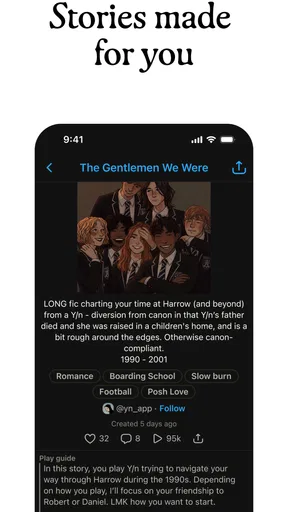
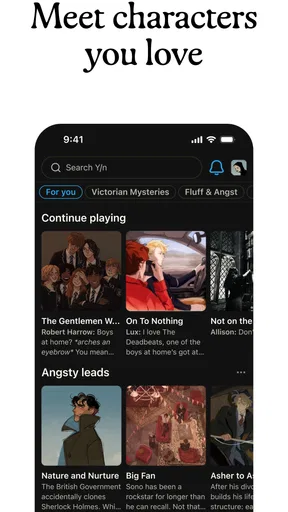
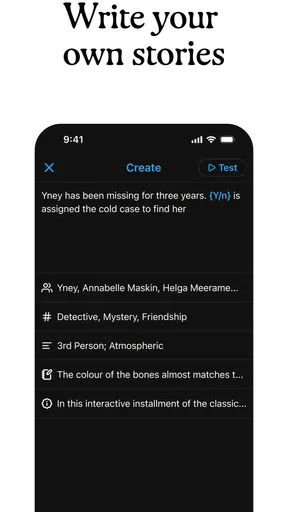
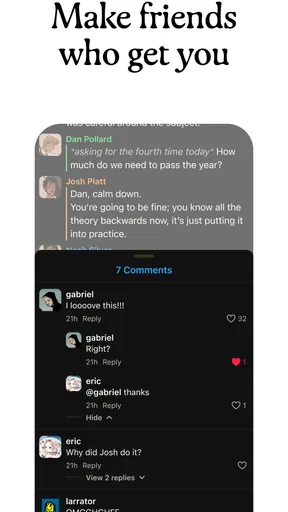


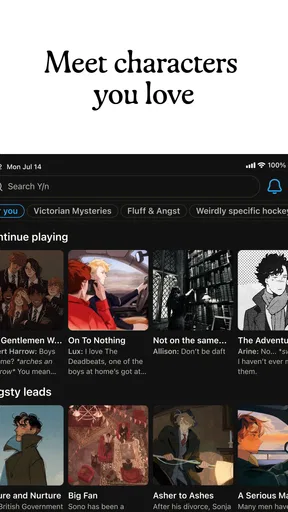
Our Review of Y/n
 Analysis by Appyee
I approached Y/n as a reading app first and as an interactive entertainment experience second. Its short store description, “Y/n,” gives away very little, while the broader summary, “Play your story,” points toward a format built around personal involvement rather than passive reading. After spending time with it, my main impression is that its appeal depends on whether you enjoy stepping into a story and making it feel like your own. It is not the kind of Books & Reference app I would choose for a dictionary, an ebook shelf, or a traditional reading session.
Instead, I see it as a more personal way to engage with fiction. The “Y/n” naming convention is commonly used to place the reader into a narrative, and that framing matters here: the experience asks me to think about my role in the story, not simply follow someone else’s character. That makes it easy to recommend to readers who like imaginative scenarios, character-focused writing, and stories that leave room for self-insertion. It is less convincing for anyone who wants a quiet, conventional book-reading tool with predictable navigation and no extra layer of interaction.
What the app feels like in everyday use
The first useful distinction is between reading for information and reading for participation. With a normal ebook app, I usually care about typography, bookmarks, progress tracking, and whether I can move through chapters without distraction. With Y/n, I pay more attention to the emotional position of the reader. The central question becomes, “What would I do here?” That shift gives the app its identity, but it also means the experience is more dependent on my mood and on how much I want to imagine myself inside the material.
I can picture using it after a long day when I want something lighter than a demanding novel. Rather than committing to a large book, I could open a story, settle into its premise, and make choices or interpret scenes through the perspective of the inserted reader character. That makes it a natural fit for short breaks, evening reading, or a private creative escape. I would not use it while trying to study, research a subject, or quickly look up a reference, because the app’s value comes from immersion rather than speed.
The strongest part of this format is the personal connection it can create. A conventional protagonist arrives with a defined history, personality, and set of motivations. A Y/n-style approach gives me more space to supply those elements myself. That can make familiar story situations feel more immediate, especially for readers who enjoy imagining themselves alongside fictional characters. It also makes the experience more individual: two people can read the same material and mentally inhabit it in noticeably different ways.
That flexibility has a trade-off. When a story leaves too much to the reader, I may feel less attached to the written character than I would in a carefully developed novel. Some readers want a strong protagonist with a clear voice; others prefer the freedom to project themselves into the scene. Y/n sits closer to the second group. I would therefore judge it by how comfortable I am with an intentionally open viewpoint, rather than expecting the same satisfaction I get from a fully authored literary character.
Why the trust question matters for a story app
Trust is easy to overlook when an app presents itself as entertainment, but a personalized reading experience can still involve sensitive moments. The stories I choose, the themes I return to, and the way I respond to fictional situations can reveal more about my interests than a simple reading list might suggest. I would not assume that the app handles information in any particular way beyond what is visibly explained in its own screens and controls. My practical advice is to read each permission prompt, account screen, and privacy choice instead of accepting everything automatically.
That cautious approach is especially sensible because Y/n is aimed at a Teen audience. The age label does not tell me that every story will suit every teenager, nor does it replace my own judgment about themes. If I were setting it up for a younger family member, I would look at the visible content guidance, review account options together, and make sure the person understands which choices are private and which may be connected to an account or device. The same applies to adults who prefer to keep reading habits compartmentalized.
The app comes from Emittance Inc., and its presence in the Books & Reference category helps explain how it is positioned: it is presented as a reading-oriented product rather than a general social platform or a conventional game. Still, the phrase “play your story” suggests a more active relationship with the material. That is why I would inspect the onboarding flow carefully. I want to know what the app asks me to provide, what it lets me skip, and whether I can use the core experience without sharing more personal information than necessary.
Visible controls and the choices I would check first
When I test an app like this, I do not treat a polished interface as proof that the data practices are trustworthy. I look for clear choices. Can I understand why an account is needed, if one is requested? Can I change preferences later? Is there an obvious way to manage notifications, remove saved information, or sign out? These are the controls I would actively seek in Y/n before investing time in a personal reading history.
I would also pay attention to whether a feature is optional or presented as a condition of entry. A story app should make it clear when a choice affects only the reading experience and when it affects an account, personalization, or communication outside the story. If a prompt is vague, I would postpone the decision rather than tap through it. That small habit is more useful than assuming that every permission is harmless because the app is in a book category.
The same principle applies to purchases. Y/n is free to download, but it includes in-app purchases priced from $4.99 to $14.99 per item. I would begin with the free experience and identify exactly what I can read or use without spending money. Before confirming a purchase, I would check whether it unlocks a specific item or changes access more broadly, and I would use the device’s purchase authentication so an accidental tap cannot become a charge.
This is one of the app’s practical friction points. A free starting point is useful, but the presence of paid items means I need to keep track of what is included and what is not. Readers who dislike interrupted discovery may prefer a traditional ebook purchased once, where the cost and contents are usually clearer at the outset. Readers who enjoy sampling stories may find the free entry more comfortable, provided they are willing to monitor the purchase boundary.
Data-sensitive moments during a personal reading session
The most sensitive moments are not necessarily dramatic. They can be ordinary actions such as creating a profile, saving a preference, continuing a story across devices, or choosing a title that reflects a private interest. I would pause at each of those points and ask whether the convenience is worth the information exchange. If I only want to try a story, I would avoid adding optional personal details until I understand what the app actually needs.
I would also separate fictional self-expression from real-world identity. If the app invites me to shape a reader character, I can use an imaginative name or neutral details rather than automatically entering information that identifies me. That is not a claim about how Y/n processes those details; it is simply a sensible way to reduce exposure when an app’s creative premise does not require my real identity.
Notifications deserve the same attention. A reminder about a story can be useful, but a message appearing on a shared lock screen could reveal what I am reading. I would review notification previews and disable them if privacy matters more than convenience. This is particularly relevant for a Teen-rated app, since a young reader may share a phone with family members or use a device with visible notifications.
I would take care with screenshots and shared links as well. Even when an app provides a private reading experience, anything I capture or share can leave the original context. My preferred workflow would be to read privately, avoid entering unnecessary personal information, and share only material I am comfortable associating with my account or device. Those habits do not make the app risk-free, but they give me more control over the parts I can manage directly.
Who gets the most from the format
Y/n is best suited to readers who already enjoy self-insert fiction or who want a story to feel more personally addressed. It can also work for someone who finds traditional protagonists too distant and prefers to imagine their own reactions. If I were recommending it to a friend, I would describe it as a good choice for an imaginative reader who wants a more participatory reading session without treating the app like a full console-style game.
It may also be useful for creative writing inspiration. I can read a scene and notice which choices feel natural, which emotional details pull me in, and where I want more control. That makes the app a prompt for thinking about viewpoint and character interaction. I would not treat it as a writing editor or a structured course, but it can help a reader identify the kinds of narrative situations they respond to most strongly.
On the other hand, I would steer away from it if my priority is reference material. Students looking for reliable definitions, researchers needing organized sources, and readers who want a large personal ebook library are likely to be better served by apps designed specifically for those jobs. Y/n’s identity is too tied to story participation for me to recommend it as an all-purpose Books & Reference utility.
I would also hesitate to recommend it to someone who dislikes ambiguity. Self-insert storytelling can leave emotional and descriptive space that a traditional novel would fill more explicitly. If I want a fixed plot, a carefully defined hero, and a clear authorial voice, a standard ebook reader is likely to feel more satisfying. The app’s openness is a strength only when I actually want to use my imagination.
How it compares with familiar alternatives
Compared with a standard ebook reader, Y/n feels more intimate and less universal. An ebook app normally gives me tools that work across many genres and authors, while this experience is built around a particular way of entering fiction. The trade-off is straightforward: I get a stronger sense of personal involvement, but I may lose some of the organization, breadth, and reading-tool depth I expect from a dedicated digital library.
Compared with a social reading platform, it appears more focused on my relationship with the story than on public discussion. That can be a benefit if I want to read without comments, rankings, or the pressure to share reactions. It can be a drawback if I depend on community recommendations, detailed reviews, or conversations with other readers before choosing what to read.
Compared with an interactive game, the experience is likely to feel more text-led and imagination-led. I would not install it expecting complex controls, action systems, or the production scale of a conventional mobile game. Its appeal is closer to guided narrative participation. That makes it easier to pick up for a short session, but it may not satisfy someone looking for challenge, strategy, or visible gameplay mechanics.
The paid-item model is another point of comparison. A subscription-based reading service may offer a wider catalog under one recurring payment, while a conventional ebook store may let me buy a specific title outright. Y/n’s item-based purchases can be attractive when I only want selected additions, but they require more attention at the moment of choice. I would keep a personal spending limit and avoid purchasing simply because a story has created a strong emotional cliffhanger.
Performance, compatibility, and practical expectations
The app supports Android 8.0 and later, so compatibility should be checked before installation on an older phone or tablet. Its current version is 1.3.34, which tells me the product has an active version line, but I would still update through the normal app store process and review any new prompts after an update. Changes to permissions, account screens, or purchase flows are worth noticing even when the reading experience itself feels familiar.
Because this is a mobile reading experience, I would test it in the situations where I actually plan to use it: on a small phone screen, with notifications muted, and with a weak connection if I expect to read while traveling. I would not assume that every story or personal setting behaves identically offline unless the app makes that clear. For a reliable routine, I would open the material before leaving home and avoid depending on last-minute access during a commute.
Storage and battery are also worth considering in a practical way. I would remove material I no longer need if the app allows local content to accumulate, and I would avoid leaving a bright reading screen active for long periods. These are ordinary mobile habits, but they matter more when the app is used as a frequent evening reader rather than an occasional curiosity.
What the audience response suggests, and what it cannot decide
Y/n has an average rating of 4.4 from around 1.2 thousand ratings, with over 100 thousand installs. Those figures suggest that the concept has found a real audience, but they do not tell me whether I will enjoy a particular story, how comfortable I will be with the account choices, or whether the purchase structure suits my budget. A strong overall response is encouraging; it is not a substitute for checking the app against my own reading habits.
The number of written reviews is also substantial enough to remind me that people are responding to a lived experience rather than just a store concept. I would read recent comments for practical clues about navigation, content expectations, and purchase clarity, while treating individual complaints or praise as personal experiences rather than universal guarantees. For this kind of app, fit matters more than popularity because the central feature is subjective involvement.
My own test would be simple. I would install it, explore the opening experience without entering optional details, read enough to decide whether the self-insert perspective feels natural, and then inspect the account and purchase screens before going further. If I felt engaged without feeling pressured to disclose information or spend money, I would continue. If the story format felt awkward, no rating could make it the right reading app for me.
My cautious verdict
Y/n is worth trying when you want fiction to feel personally addressed rather than simply displayed. I like the idea behind its “play your story” positioning because it gives reading a more active emotional role. The app can be a pleasant fit for imaginative readers, fans of self-insert storytelling, and anyone looking for a different kind of short mobile escape.
My recommendation comes with clear boundaries. I would not replace a dependable ebook reader, reference tool, or social book community with it. I would also approach the free download and paid items carefully, review every visible account and permission choice, and keep notifications private if the reading material is personal. The Teen age rating is another reason to consider the individual reader and the themes they are comfortable with, rather than treating the label as a universal suitability guarantee.
In the end, I see Y/n as a focused narrative app with a distinctive point of view, not a complete reading ecosystem. Its best quality is the way it invites me into the story; its biggest limitation is that this same format will not appeal to readers who prefer fixed characters, broad reference features, or one-time purchases. If that trade-off sounds attractive, the free entry makes a cautious trial reasonable. I would keep control of my information and spending from the beginning, then let the writing—not the promise of personalization alone—decide whether it earns a lasting place on my phone.
Privacy and Permissions
See what permissions an app requests and how it handles your data.
- Photos/Media/Files
- read the contents of your USB storage, modify or delete the contents of your USB storage
- Storage
- read the contents of your USB storage, modify or delete the contents of your USB storage
- Camera
- take pictures and videos
- Microphone
- record audio
- Other
- view network connections, change network connectivity, full network access, run at startup, draw over other apps, control vibration, prevent device from sleeping, Google Play license check
Verdict
Strengths of Y/n
- Simple interface that is easy to understand from the first launch.
- Runs smoothly on most modern Android and iOS devices.
- Useful features are organized for quick access.
- Regular updates can improve stability and add new content.
- Suitable for both casual users and people who use it frequently.
Limitations of Y/n
- Some advanced features may require a paid subscription.
- Performance can vary on older or less powerful devices.
- The app may request permissions that some users find intrusive.
- Certain functions may depend on a stable internet connection.
- Notifications could become distracting if not adjusted in settings.
Similar Picks in This Category
View All
Google Play Books & Audiobooks
Google LLC4.7

네이버 - NAVER
NAVER Corp.3.5

Wattpad - Read & Write Stories
Wattpad.com3.7

King James Bible - Verse+Audio
Ozion4.8

Bible Offline-KJV Holy Bible
Bíblia Offline4.9

Amazon Kindle: Reading App
Amazon Mobile LLC4.8
Frequently Asked Questions
What is Y/n and what can I use it for?
Y/n is an app or game title that may refer to different products depending on the developer and platform. Before downloading, check the official store listing to confirm its purpose, screenshots, age rating, supported devices, and latest update. The description should clearly explain the main features, required permissions, and whether the app is intended for entertainment, communication, productivity, or another use.
Is Y/n free to download and does it include in-app purchases?
The download price and available payment options can vary between Android and iOS. Although Y/n may be free to install, it could include advertisements, premium features, subscriptions, virtual items, or one-time purchases. Review the store’s pricing section carefully before installing, and check subscription terms so you understand renewal dates, cancellation procedures, and any limits placed on free users.
What permissions and personal information does Y/n require?
Before granting access, review the permissions requested by Y/n and consider whether they match the app’s purpose. Depending on its features, it may request access to notifications, storage, the camera, microphone, location, contacts, or an account login. Read the privacy policy and data-safety information in the official listing, and avoid providing sensitive information unless it is genuinely necessary.
Can Y/n be used offline, and what devices does it support?
Offline functionality depends on how Y/n is designed. Some features may work without an internet connection, while account authentication, synchronization, advertisements, multiplayer tools, or online content may require Wi-Fi or mobile data. Check the minimum Android or iOS version, available storage requirements, and device compatibility before downloading, especially if you use an older phone or tablet.
Is Y/n safe and suitable for all users?
Safety and suitability depend on the verified developer, store rating, content, advertising practices, and age classification. Download Y/n only from Google Play, the Apple App Store, or another trusted official source, and avoid modified versions from unknown websites. Parents should review the age rating, chat features, purchases, and privacy settings before allowing children or teenagers to use it.
